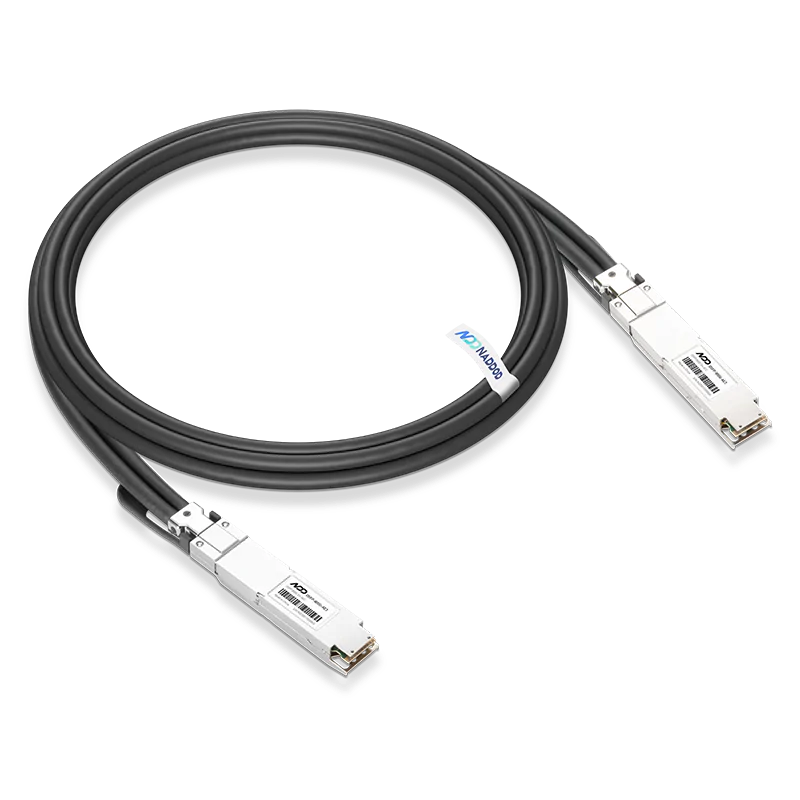
Generic Compatible ACC 5m (16ft) Twin-port 2x400Gb/s OSFP Flat Top to 2x400Gb/s OSFP Flat Top Active Copper Cable

#103743
Model: OSFP-800G-AC5F
Sold: 0
In Stock: Available
US$

Item Spotlights

  • Low-latency, Low-power, Higher port bandwidth, density, and configurability, reduced power requirement in the data centers.
  • Provide Professional Compatibility and Parameter Test Reports.
  • Free test environment and samples are available to experience the high-quality product performance.
  • Complies with OSFP MSA, CMIS, and RoHS protocols, providing a reliable and sustainable solution.
  • 30-Day Free Return, 1-Year Free Replacement, 3-Year Warranty, Lifetime After-sales Technical Support.
5m (16ft) Twin-port 800Gb/s OSFP Flat Top to 800Gb/s OSFP Flat Top Active Copper Cable for Generic
Generic Compatible ACC 5m (16ft) Twin-port 2x400Gb/s OSFP Flat Top to 2x400Gb/s OSFP Flat Top Active Copper Cable
Specifications
Applications
Product Highlights
Questions & Answers
Resources
Specifications
Applications
Product Highlights
Questions & Answers
Resources

Description

Generic Compatible ACC 5m (16ft) Twin-port 2x400Gb/s OSFP Flat Top to 2x400Gb/s OSFP Flat Top Active Copper Cable

NADDOD OSFP-800G-AC5F is a 2x400Gb/s twin-port OSFP (Octal Small Formfactor Pluggable) Flat Top to 2x400Gb/s twin-port OSFP Flat Top Active Copper cable (ACC). ACC is an active DAC with a pre-emphasis equalizer IC included in each end, enabling cable lengths of up to 5 meters. Using the Octal Small Formfactor Plug (OSFP) and containing eight high-speed electrical copper pairs, each operating at data rates of up to 100Gb/s. NADDOD’s cable solutions provide power-efficient connectivity enabling higher port bandwidth, density and configurability at a low cost and reduced power requirement in the data centers.

Specifications

Form Factor
OSFP to OSFP
Distance
3m~5m
Wire AWG
26AWG~30AWG
Commercial Temperature Range
0~70°C(32 to 158°F)
Jacket Material
PET
Power Consumption
<1.5W
Minimum Bend Radius
10x OD
Application
800G Ethernet Compliant

Applications

Product Highlights

Questions & Answers

Ask a Question
Q:
What is the difference between ACC, DAC, and AEC?
A:
DAC (Direct Attach Cable) is a passive copper cable without built-in chips, offering very low power consumption but supporting only short transmission distances (typically ≤3 m). ACC (Active Copper Cable) integrates linear amplification and equalization chips, providing lower power consumption than AEC while typically supporting transmission distances of 3–5 m. AEC (Active Electrical Cable) incorporates DSP retimer chips with stronger signal processing capability, enabling longer transmission distances but with higher power consumption and cost. Overall, ACC sits between DAC and AEC, balancing cost, power consumption, and transmission distance.
Q:
How does the wire gauge (AWG) of ACC cables affect performance?
A:
Thicker wire (lower AWG number) results in lower insertion loss, enabling longer distances or more stable signal transmission. However, it increases cable stiffness and requires a larger bending radius. Common 26AWG and 28AWG solutions are selected based on distance requirements.
Q:
What are the recommended application scenarios for the OSFP-800G-ACC RHS?
A:
It is primarily used for server network interface cards (NIC) side ports. Unlike switch-side modules with finned tops, the Flat Top (RHS) structure features a flush top surface and a more compact form factor. This design fits the tighter NIC cage structures found in servers or GPU nodes, ensuring mechanical compatibility and installation stability for cables within server environments.
View More

Quality Certification

ISO140012015
ISO 90012015
ISO450012018
FDA
FCC
CE
RoHS
TUV-Mark
UL
WEEE

What We Supply